

Turn what your company knows into the answers it needs.
We design RAG systems that allow people and customers to query company documents and data through AI with references to sources and defined access rules.
Outcome
Answers in business data with AI
Engagement
From analysis to implementation
Scope
4-10 weeks
Opportunity
Your company's knowledge, available to those who need it.
A procedure helps manage a request, a product sheet guides a purchase, a guideline gives coherence to communication and value emerges when this information is easy to access. Designing access to this information through AI allows you to bring corporate knowledge into daily activities.
Knowledge
People ask a question in natural language and receive a response built on relevant content retrieved from authorized company sources.
Relevance
Questions about your work need answers in the right context. AI uses your company's technical documentation, procedures and product content to formulate them.
Responsibility
Knowledge flows but, rules remain. Everyone has access to the information they're authorized to access, while those responsible ensure its quality and up-to-dateness.
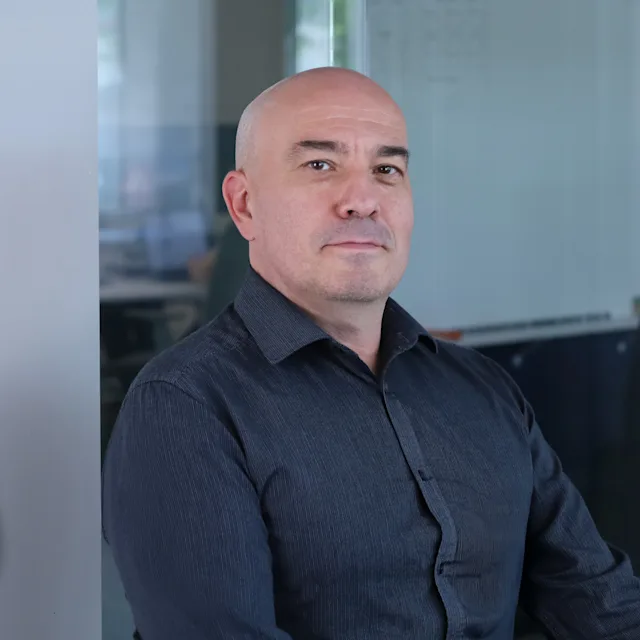
Marco Fabbri
Chief Technology Officer
Seen up close
«For me, AI is valuable when it solves real-world problems. Our challenge is to bring corporate knowledge to those who need it, without searching through thousands of documents and with careful attention to protecting the information.»
The Solution
Less time spent searching. More knowledge at work.
With RAG, documents and data become a resource accessible through AI, providing relevant answers to people's questions. We start with your objectives and design the solution around the activities to be supported, connecting useful sources and defining access rules to bring knowledge where it's needed for your business.
Priority
We identify the people we need to support, the recurring questions, and the activities where knowledge can make a difference. We define an initial use case and the objectives for evaluating its usefulness.
Sources
We select documents, data and platforms relevant to the project. We evaluate quality, timeliness, and authorizations and design connections with repositories, catalogs and corporate systems.
Architecture
We organize knowledge through categories, metadata, and access rules. The RAG Architecture Blueprint describes how to retrieve information and make it available for each role and channel.
Relevance
A useful response starts with the right information. We design content retrieval and its use by AI, then test the system with questions drawn from real-world work.
Responsibility
We define permissions, source references and human involvement. Requests requiring specific assessments or authorizations are routed to the appropriate person, along with the available context.
Evolution
Questions, answers and feedback reveal where to intervene. We use these insights to update knowledge, improve service and extend it to other company activities.

What's happening in your company
More knowledge available to people, more opportunities for business.
01
Simplicity
A question, without having to know where to look. Documents, code and procedures become accessible in natural language, allowing you to find the information you need for your daily work.
02
Traceability
Not just answers: also sources for further exploration. People can trace the content used by AI and consult it within their permissions.
03
Harmony
When expertise is needed, the right person steps in. Requests requiring an assessment are passed on to those who can handle them, along with the information already gathered.
04
Check
Responsible parties, update rules and access rules make the management of the sources used by AI explicit.
05
Evolution
The experience of the first use case helps identify other activities in which making knowledge accessible can generate value.
Process
From your priorities to an AI ready to work.
We start with a concrete priority and build the path together with the people who will use and manage the system. Each phase explicitly defines expected results, responsibilities and verification criteria, right up until production.
Analysis
We delve into the questions, activities and available sources. We identify the priority use case, the people involved and the starting indicators.
Design
We define the knowledge architecture, integrations, and response rules. The blueprint clarifies access, responsibilities, and evaluation criteria.
Realization
We build the system and connect the required sources. We verify responses, permissions, and performance on representative requests, involving the people who will use the service.
Go Live
We support the release and transfer knowledge useful for management. Usage, evaluation and feedback guide updates and subsequent development opportunities.
What sets us apart from others
The difference is in the way activities are organized around the business.
Our approach connects architecture, data, and processes to prevent growth from generating new fragmentation: we transform operational complexity into strategic clarity, aligning decisions and priorities with business outcomes.
The standard approach
- Systems, marketing and AI proceed in silos with separate logic and priorities.
- Existing solutions are adapted to contexts with different constraints.
- Intervention is initiated only after the problem has emerged and costs have already increased.
- Technology, growth and relationships are distributed across different vendors.
- The project is measured by distinct outputs, not by system convergence.
The Redify Model
- We integrate systems, marketing and AI toward a single business direction.
- We start from the points of friction to build what's really needed.
- We design architectures and paths based on the client's constraints, stack and objectives.
- A single method to make technology, growth and relationships work together.
- We protect what matters: control, speed, direction and growth capacity.
Designed for your role
Shared knowledge, a recognizable value for every role.
Technology, digital channels, marketing and AI contribute to the quality of corporate knowledge. We design the service so that each function can recognize its own objective and collaborate to achieve it.
CTO
Bring knowledge access into the corporate ecosystem with defined integrations, identities, and permissions. Procedures and technical documentation can be accessed through AI, with clear update and management criteria.
Head of Digital
Make product content, guides, and service information accessible at key points along the customer journey. The questions you gather can guide the evolution of your content and digital experiences.
CMO
Guidelines, content and product information available to those who communicate with the market. A shared foundation can support responses that are consistent with the brand and the customer's context.
CDO e AI Expert
Connect the digital roadmap objectives to the implementation of the RAG use case. Defined sources, assessments, and responsibilities help verify the service's usefulness and guide its adoption across the involved functions.
Related Insights

How to choose the best SEO agency for fashion and luxury
Choosing an SEO agency for fashion and luxury requires a different approach than usual: a guide for CMOs and Heads of Digital on how to evaluate SEO/GEO integration and the partner's true alignment with seasonal, multilingual, and multi-market catalogs, without sacrificing positioning and exclusivity.

Giuliano Torelli
Chief Marketing Officer

The perfect platform does not exist: how to choose the right tech stack for your business
There's no such thing as a perfect platform: a quantitative framework to guide Fashion & Accessories leaders in choosing the e-commerce infrastructure best suited to their business.

Marco Fabbri
Chief Technology Officer

Headless, Composable o MACH? How to choose the right ecommerce architecture in B2B manufacturing
Headless, Composable, or MACH: the wrong choice generates technical debt and risky migrations. A guide for manufacturing CTOs and CIOs on how to select the right ecommerce architecture for your business.
Marco Fabbri
Chief Technology Officer









We put what your company knows to work.
Let's talk about the information your people and customers need. Together, we'll identify where RAG can make a concrete contribution to your business.